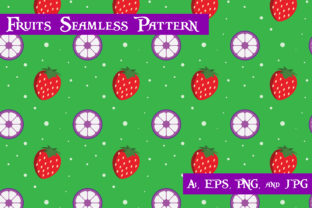
Mangosteen and Strawberry Seamless: A Versatile Digital Pattern for Creative and Commercial Use
Designers, educators, product developers, and small business owners increasingly rely on high-quality, adaptable digital assets to accelerate workflows and strengthen visual identity. Among these assets, Mangosteen and Strawberry Seamless stands out—not as a fleeting trend, but as a thoughtfully composed pattern rooted in botanical contrast and color harmony. Unlike generic fruit motifs, this seamless design merges the deep purple richness of mangosteen rind with the vibrant red gloss of ripe strawberries, creating a balanced, repeatable surface that functions equally well in print, web, packaging, and educational materials.
What Makes This Pattern Technically Seamless—and Why It Matters
A seamless pattern repeats infinitely without visible edges or misaligned seams. The Mangosteen and Strawberry Seamless achieves this through precise tile alignment, consistent spacing, and intentional negative space management. Each tile unit is constructed so that the outermost pixels of the mangosteen’s calyx and the strawberry’s seeds align perfectly with adjacent tiles—no manual cloning or offsetting required. This technical integrity means users can scale the pattern across banners, textiles, or presentation backgrounds without distortion or visual breaks.
For professionals working under tight deadlines—such as marketing coordinators preparing social media kits or educators designing classroom posters—the reliability of true seamlessness saves hours. A non-seamless fruit pattern may appear cohesive at thumbnail size but reveal jarring gaps or duplicated stems when enlarged to full-screen resolution. With Mangosteen and Strawberry Seamless, scaling is predictable, whether applied to a 4K monitor background or a 3-meter retail display.
File Format Flexibility: AI, EPS, PNG, and JPG—Each Serves a Distinct Purpose
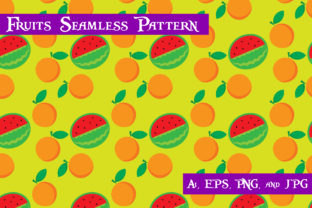
The availability of four complementary file formats—AI (Adobe Illustrator), EPS (Encapsulated PostScript), PNG (Portable Network Graphics), and JPG (Joint Photographic Experts Group)—ensures broad compatibility and functional precision across use cases:
- AI files are vector-based and fully editable: designers can recolor individual fruits, adjust stem curvature, or isolate elements for custom layouts—all without quality loss.
- EPS files offer cross-platform vector support, especially valuable for legacy prepress workflows or collaboration with print vendors using older RIP (Raster Image Processor) systems.
- PNG files include transparent backgrounds and lossless compression—ideal for web overlays, UI elements, or layered mockups where blending with existing color schemes is essential.
- JPG files provide optimized raster output for fast-loading websites, email newsletters, or internal documentation where editability is secondary to speed and universal readability.
This multi-format approach reflects real-world production needs. A textile designer sourcing patterns for fabric printing may start with the AI file to adjust repeat dimensions, then export a high-res JPG for client presentations. Meanwhile, a science teacher building an interactive botany module might drop the transparent PNG directly into a slide deck—preserving crisp edges against variable slide backgrounds.
Botanical Accuracy Meets Design Intention
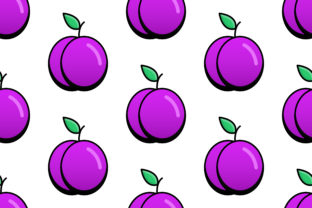
While stylized, the Mangosteen and Strawberry Seamless pattern retains recognizable anatomical features: the mangosteen’s leathery, four-lobed calyx and subtle radial striations; the strawberry’s dimpled surface, seed distribution, and tapered green sepals. This fidelity supports educational applications—biology instructors use it to spark observation exercises (“Count the calyx lobes,” “Compare seed density between fruits”)—while still serving aesthetic goals in branding or packaging.
Color values are calibrated for both screen and print fidelity. The mangosteen’s purple uses a CMYK-safe blend (C65 M90 Y50 K25) that avoids excessive ink saturation, reducing drying time and registration issues on coated stock. The strawberry red leans slightly toward magenta rather than pure scarlet, enhancing contrast against the purple while remaining accessible to viewers with common forms of red-green color vision deficiency.
Educational Tools and Visual Learning
In classrooms and online learning platforms, repeating patterns help reinforce concepts through repetition and visual rhythm. A middle school nutrition unit might feature the Mangosteen and Strawberry Seamless as a background for infographics comparing tropical versus temperate fruit nutrients. The dual-fruit motif invites comparative analysis—students examine differences in vitamin C concentration, fiber content, or cultivation regions without relying solely on text.
Product Packaging and Sustainable Branding
Food startups launching antioxidant-rich snack lines or cold-pressed juices often seek packaging that signals freshness and botanical authenticity. This pattern provides a ready-made, licensable alternative to commissioning custom illustrations—reducing time-to-market from months to days. Its warm yet sophisticated palette avoids the overly sweet connotations of cartoonish fruit graphics, supporting premium positioning. Importantly, because the design avoids photorealism, it sidesteps seasonal limitations: unlike stock photos showing overripe or bruised produce, the Mangosteen and Strawberry Seamless presents both fruits in ideal, timeless condition.
Digital Interface and Presentation Design
UI/UX designers incorporate subtle fruit-based textures to add warmth to otherwise minimalist dashboards or reports. When applied at low opacity (10–15%) as a background layer behind data visualizations, the pattern adds tactile depth without competing with charts or tables. Similarly, corporate trainers use it as a consistent visual thread across slide decks—reinforcing brand identity while maintaining readability of dense content.
Craft and Hobbyist Projects
Hobbyists creating greeting cards, scrapbook pages, or DIY gift wrap value the pattern’s balance of detail and simplicity. The strawberries’ glossy highlights and mangosteens’ matte texture provide natural visual interest even when printed on standard home printers. Because the tile size is modular (typically 2000×2000 px or 8×8 inches at 300 dpi), users can easily crop sections to fit standard card dimensions or adapt them for laser-cut stencils.
Considerations for Ethical and Inclusive Implementation
While visually engaging, the use of fruit motifs carries implicit cultural associations. Mangosteen—often called the “queen of fruits” in Southeast Asia—is deeply tied to regional agriculture and food sovereignty. Strawberry cultivation, by contrast, involves complex global supply chains and labor considerations. Thoughtful implementation acknowledges this context: educators might pair the pattern with discussion prompts about fair trade certification or climate resilience in fruit farming. Brands using the design in packaging should avoid implying origin claims unless verified—e.g., labeling a product “mangosteen-infused” when only flavoring is used, or suggesting local sourcing for a globally distributed fruit.
Accessibility also extends beyond color contrast. When used as a background for text, ensure sufficient luminance difference—test with tools like WebAIM’s Contrast Checker. For presentations, avoid placing light-colored text directly over strawberry highlights or dark text over deep mangosteen shadows. A simple solution: overlay a semi-transparent neutral tone (e.g., 15% white or black) before adding body copy.
Workflow Integration: From Download to Deployment
Most users begin by downloading the preferred format, then integrate it based on their software ecosystem:
- For Adobe Creative Cloud users: Drag the AI file into Illustrator, ungroup layers to access individual fruits, then use “Object > Pattern > Make” to tweak tile size or spacing before saving a custom swatch.
- For Canva or Figma users: Upload the PNG or JPG, set it as a background fill, and use the “repeat” or “tile” option in the fill settings—no vector editing needed.
- For developers embedding in websites: Use the JPG or PNG as a CSS background-image with
background-repeat: repeat;. For responsive behavior, pair withbackground-size: contain;or define fixed pixel repeats for consistency across devices. - For print production: Open the EPS in Illustrator or InDesign, embed (not link), and confirm color mode matches the printer’s requirements—CMYK for commercial offset, RGB only for digital presses with calibrated profiles.
This flexibility reduces friction between creative intent and technical execution—a key factor for time-constrained teams managing multiple deliverables.
Long-Term Value Beyond Aesthetics
Unlike trending design elements that fade within a season, botanical patterns grounded in real plant morphology demonstrate lasting relevance. The Mangosteen and Strawberry Seamless benefits from dual recognition: strawberries enjoy near-universal familiarity, while mangosteens introduce gentle novelty—sparking curiosity without alienating audiences. That balance supports longevity in brand systems, educational resources, and product lines aiming for multi-year shelf life.
Moreover, its versatility across file types and applications means a single acquisition serves multiple departments: marketing uses it for campaign assets, R&D incorporates it into lab notebooks, and customer experience teams apply it to digital onboarding flows. That cross-functional utility amplifies return on investment—not in monetary terms alone, but in consistency, coherence, and shared visual language.
Ultimately, the strength of Mangosteen and Strawberry Seamless lies not in ornamental excess, but in considered restraint: a repeatable, accurate, technically sound foundation that empowers users to build meaning—not just visuals—around two distinct yet harmonious fruits.